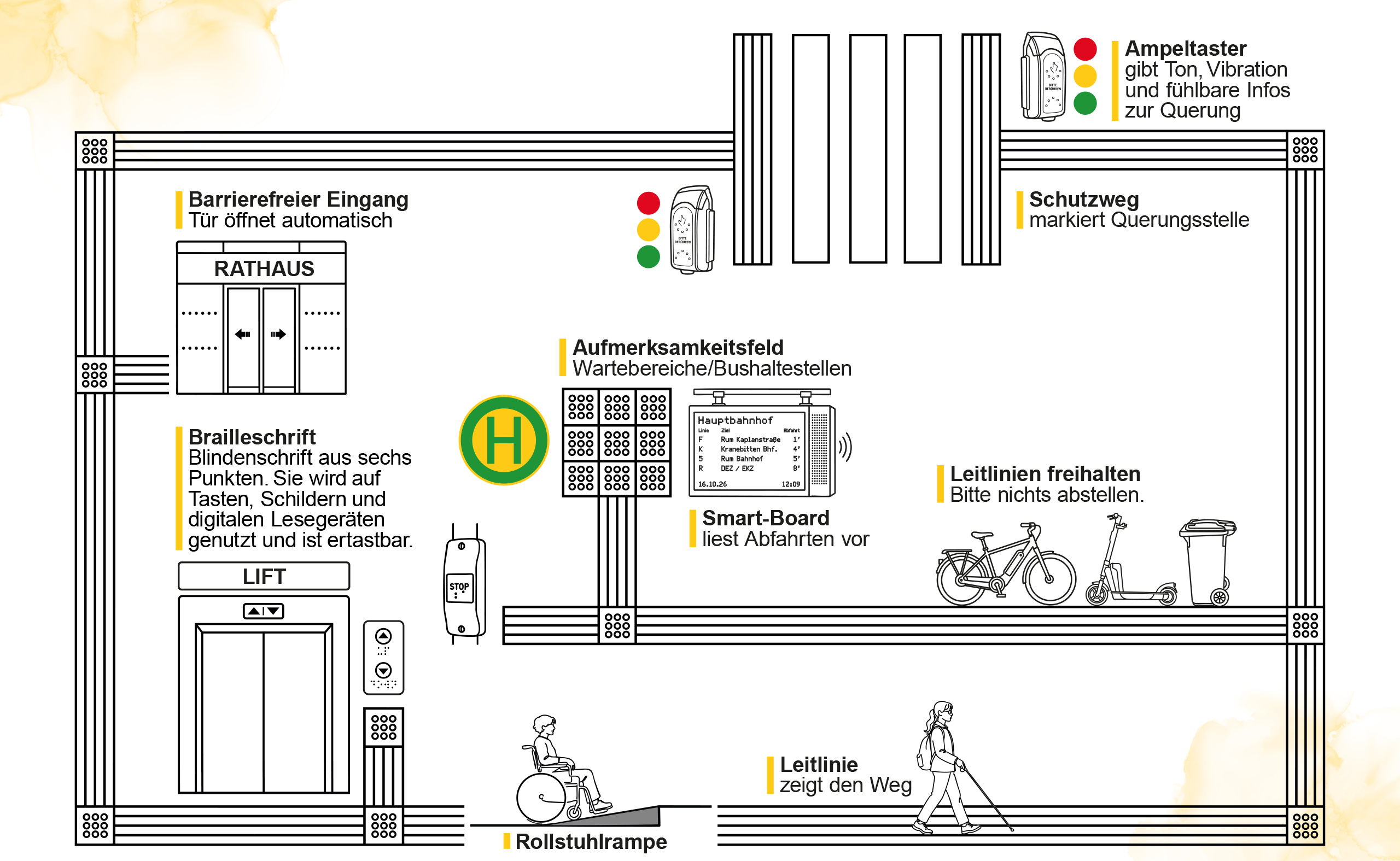
Content of the information board on site
The sign shows various aids for people with disabilities in public spaces:
- Guidance lines on the ground show the way and help with orientation. At pedestrian crossings, guide lines and stop lines mark the point where people can cross the road safely.
- An accessible entrance with an automatic door allows easy access to buildings.
- Braille on buttons, signs or equipment helps blind people and those with visual impairments.
- Guidance lines on the floor lead directly to the lift control panel. The buttons are marked with Braille and can be felt by touch.
- A wheelchair ramp enables users to negotiate changes in level.
- Markings at stops indicate where people who are blind or have a visual impairment can wait for buses and trams. Drivers stop here and call out their route number and direction of travel.
- A smart board at stops can read out departure times and information.
- A traffic light button provides audible and tactile signals to ensure safe crossing of the road.
- Horizontally striped guide lines at pedestrian crossings mark the safe area for waiting and crossing the road.
- The guide lines must remain clear and must not be blocked by people, bicycles, e-scooters or other objects.
© Stadt Innsbruck/K. Iwanowa
Further information – Braille
Why does Braille exist?
The invention of written characters some 5,000 years ago ranks among humanity’s most significant cultural and historical achievements. For many millennia, the cultural skills of reading and writing were the privilege of a small minority. This changed with the invention of the printing press, which greatly facilitated the dissemination of books and magazines, and the development of public education during the Age of Enlightenment.
Until then, blind people had been excluded from these cultural skills. There was no form of writing that was easily legible to blind people, although teachers in the early schools for the blind endeavoured to make letters tactile, like relief carvings, in order to teach pupils to read and write. However, all these attempts met with little or no success.
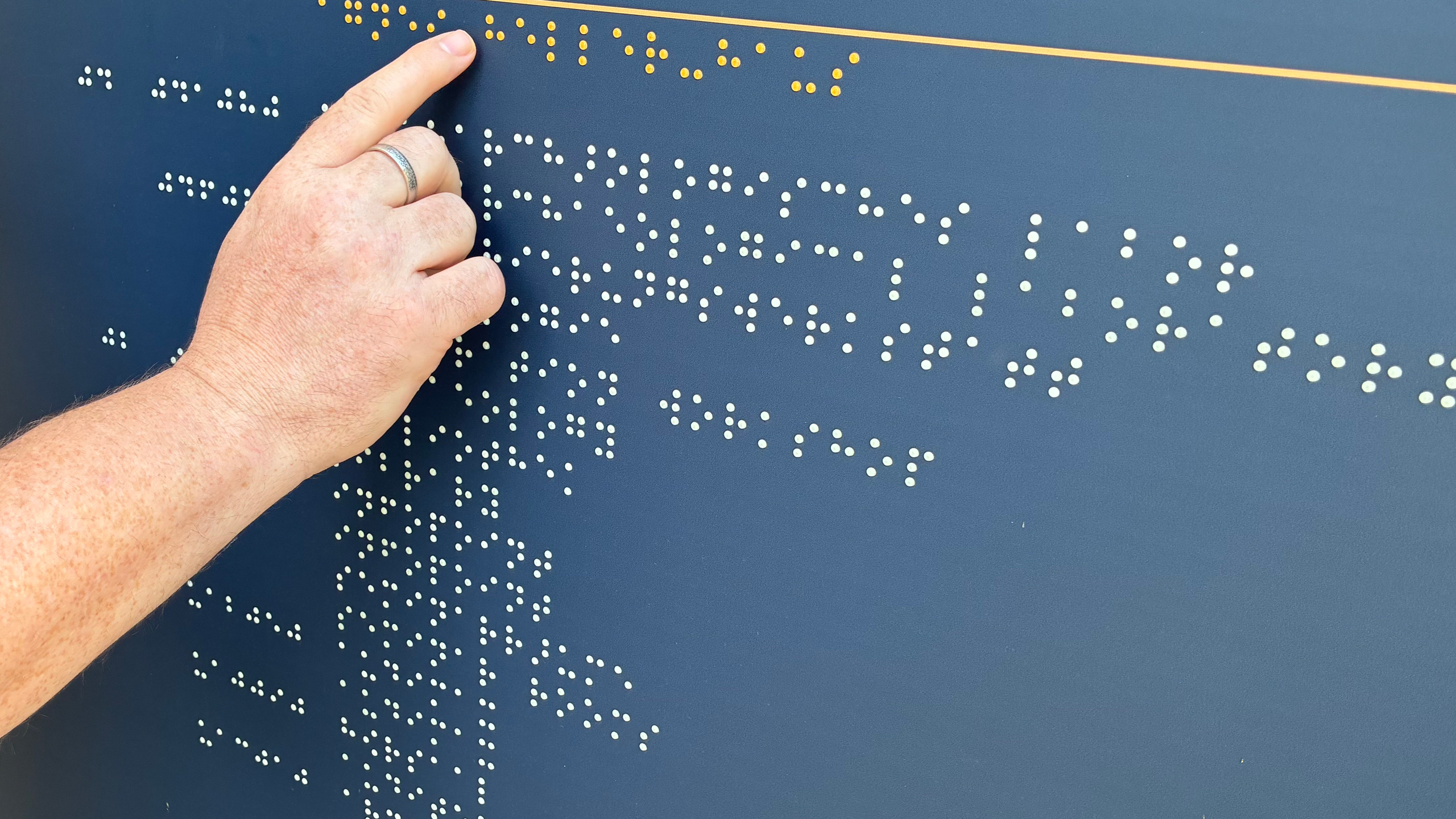
Thanks to Braille, people who are blind or have a visual impairment can read. © Stadt Innsbruck/W. Grünzweig
Who invented Braille and how does it work?
It was 16-year-old Louis Braille who put an end to this predicament. In 1825, he presented an alphabetic system consisting of six dots. The six dots are arranged like the six on a dice. It is precisely this 6-dot grid that is ideally suited to being felt with the fingertips and thus to reading. The combinations of the 6 dots can be used to represent all the letters of the alphabet, all punctuation marks, accented letters and diphthongs such as ‘au’, ‘ei’, ‘ch’ and ‘sch’.
Initially, Braille – as it is also known – was rejected by educators of the time because it differed too greatly from the writing system used by sighted people. In practice, however, the system has become established and today Braille is used worldwide – there are even Braille systems for Chinese and Japanese.
Braille is also flexible enough to represent musical notes, mathematical, physical and chemical symbols, and, above all, many accent marks in foreign languages.
Is Braille also used digitally?
Yes, Braille has been adapted for computer use for around 50 years. However, the 6-dot field had to be extended to 8 dots in order to be able to display the many additional characters. Today, computers are also indispensable for blind people in the workplace and for everyday needs.
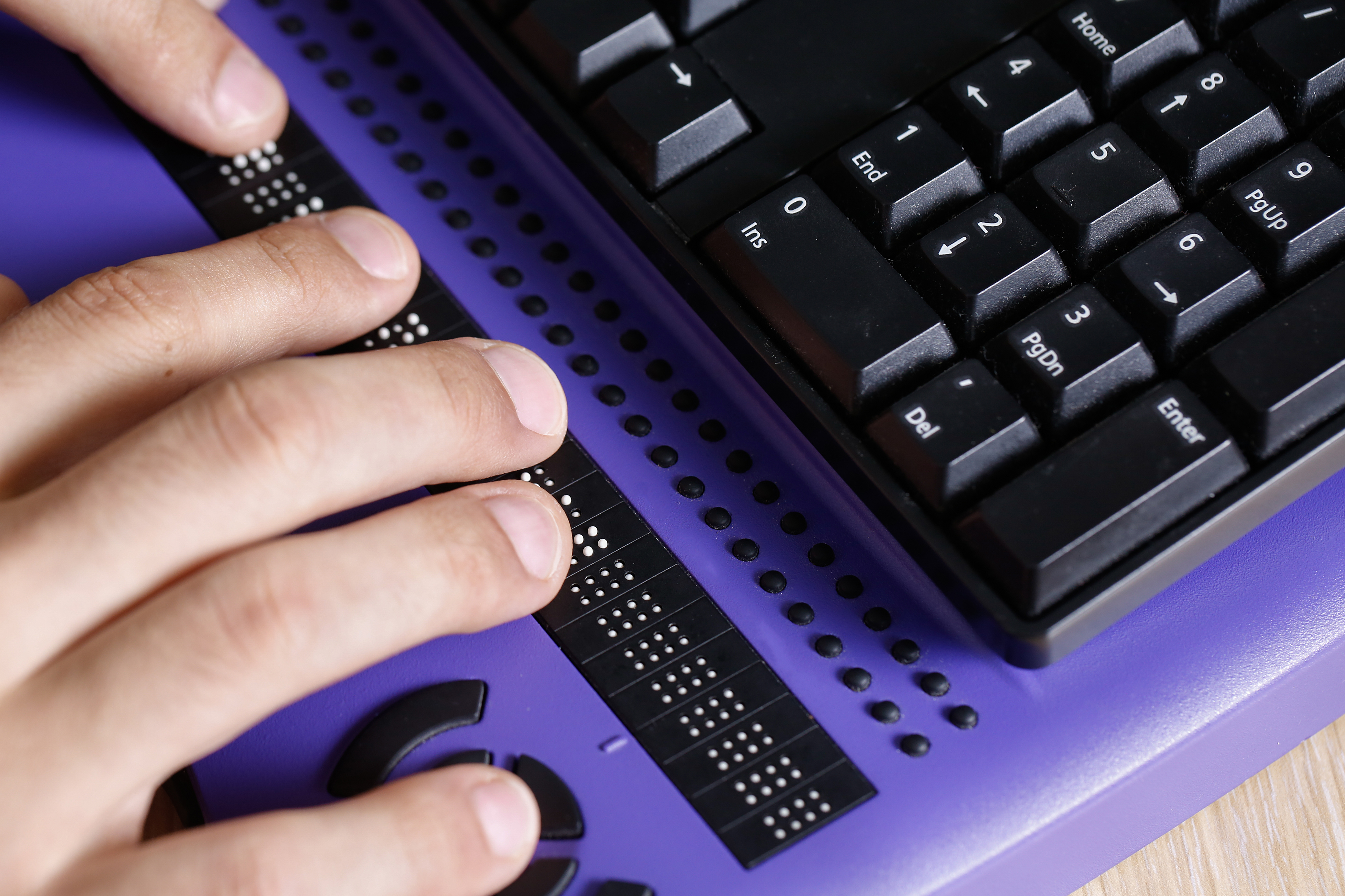
With a Braille display, it is possible to use Braille on a computer as well. © AdobeStock_111988841
How does Braille help in public spaces?
Braille is used in public spaces to help blind people find their way around or to facilitate barrier-free access to information. For example, at Innsbruck railway station, there are Braille signs at the entrances to the platforms. Many lifts in public buildings are labelled in Braille. There are restaurants that offer menus in Braille, hotels that label their room doors in Braille, and many museums and botanical gardens with information boards featuring text in Braille. The city of Innsbruck has redesigned the walking trail along the River Sill and, in doing so, has replaced the information boards. Each board features a relief that is easy to feel, along with a brief description in Braille.
Text: Klaus Guggenberger, qualified teacher, former chairman of the Tyrolean Association for the Blind and Visually Impaired, adapted and supplemented by the web editorial team
Orientation
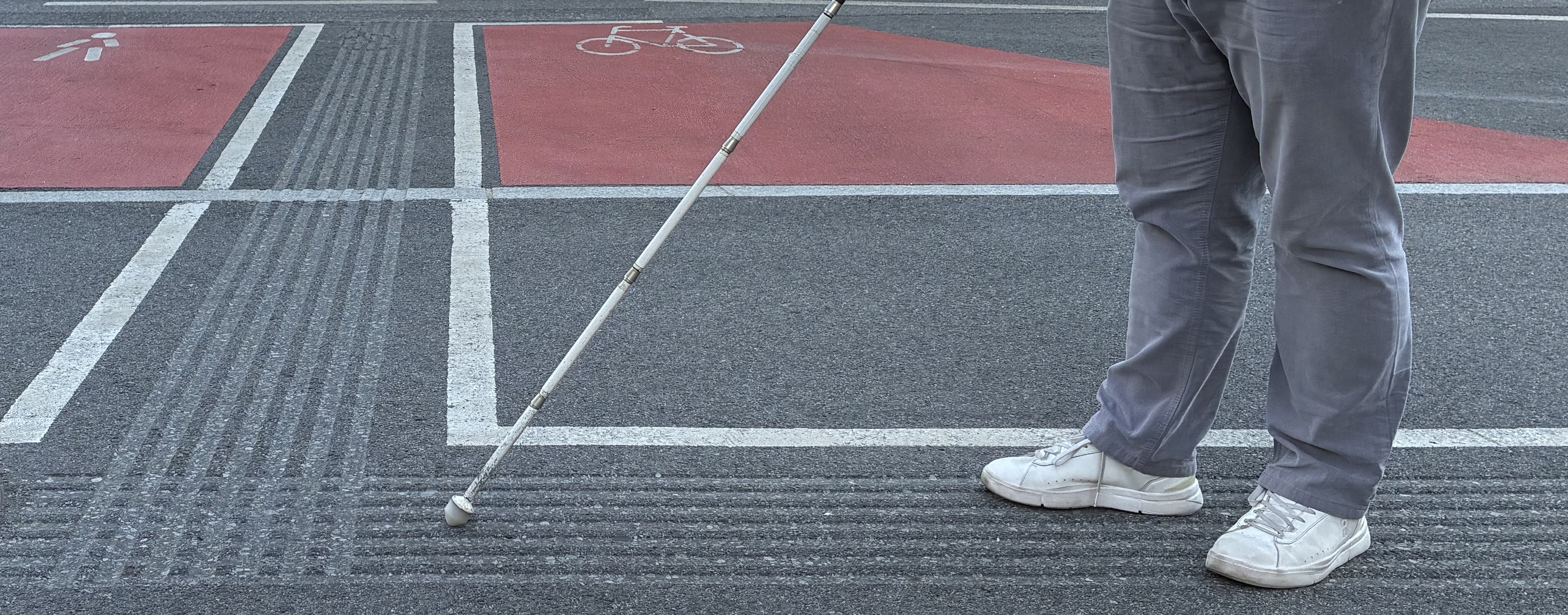
A person uses a long white cane to follow milled guide lines. © Stadt Innsbruck/W. Grünzweig
How do people who are blind or visually impaired find their way around?
People who are blind or have a visual impairment very often use tactile guides in public spaces to find their way. These can take many different forms, such as building walls, kerb edges, drainage channels (i.e. grated drains), lawn edges or the difference between a paved path and the grassy area alongside it. These features have one thing in common: they must be clearly distinguishable and free from obstacles so that they can be used safely.
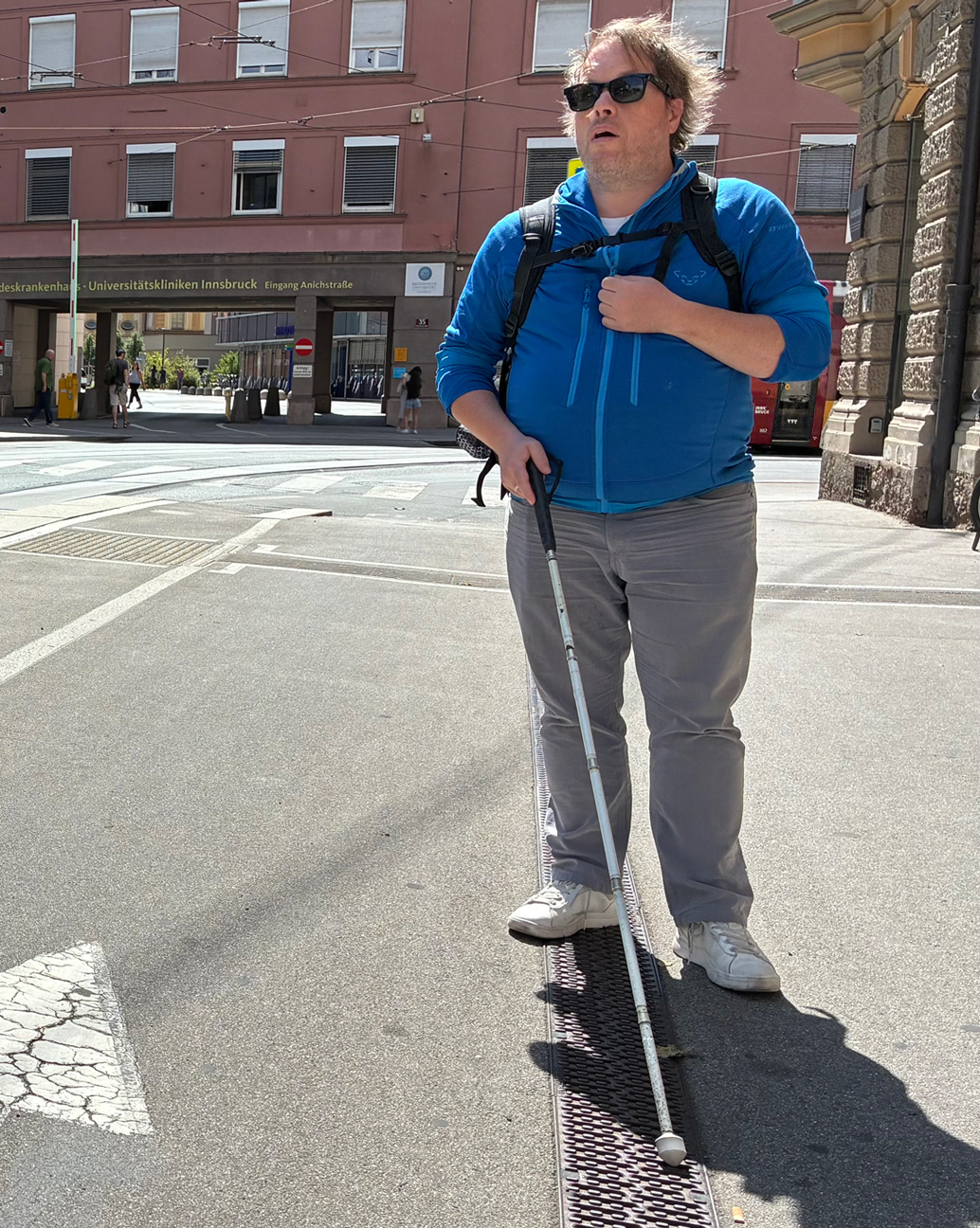
Drainage channels as guide lines© Stadt Innsbruck/W. Grünzweig
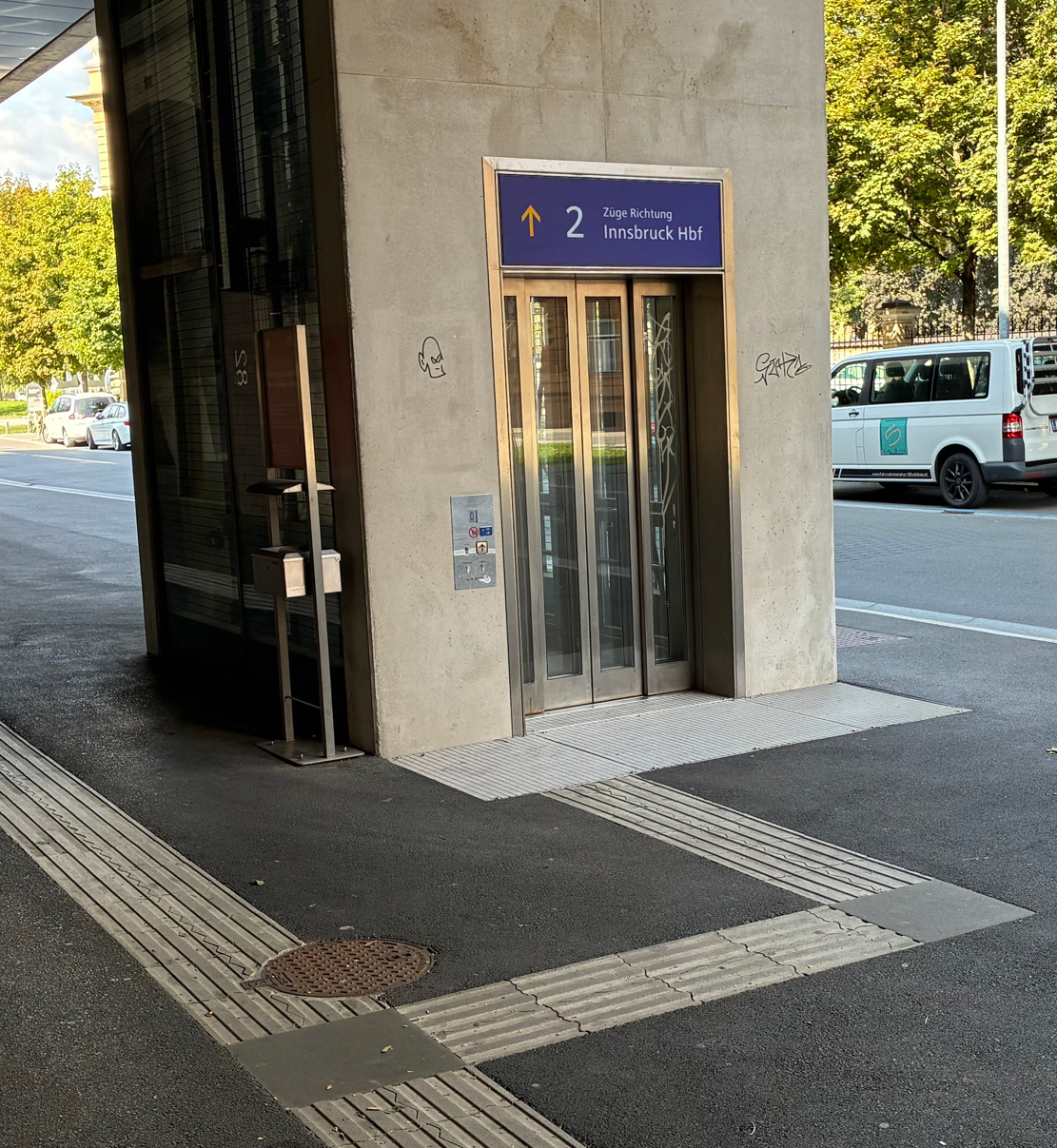
The guide rails lead directly to the lift buttons. © Stadt Innsbruck/W, Grünzweig
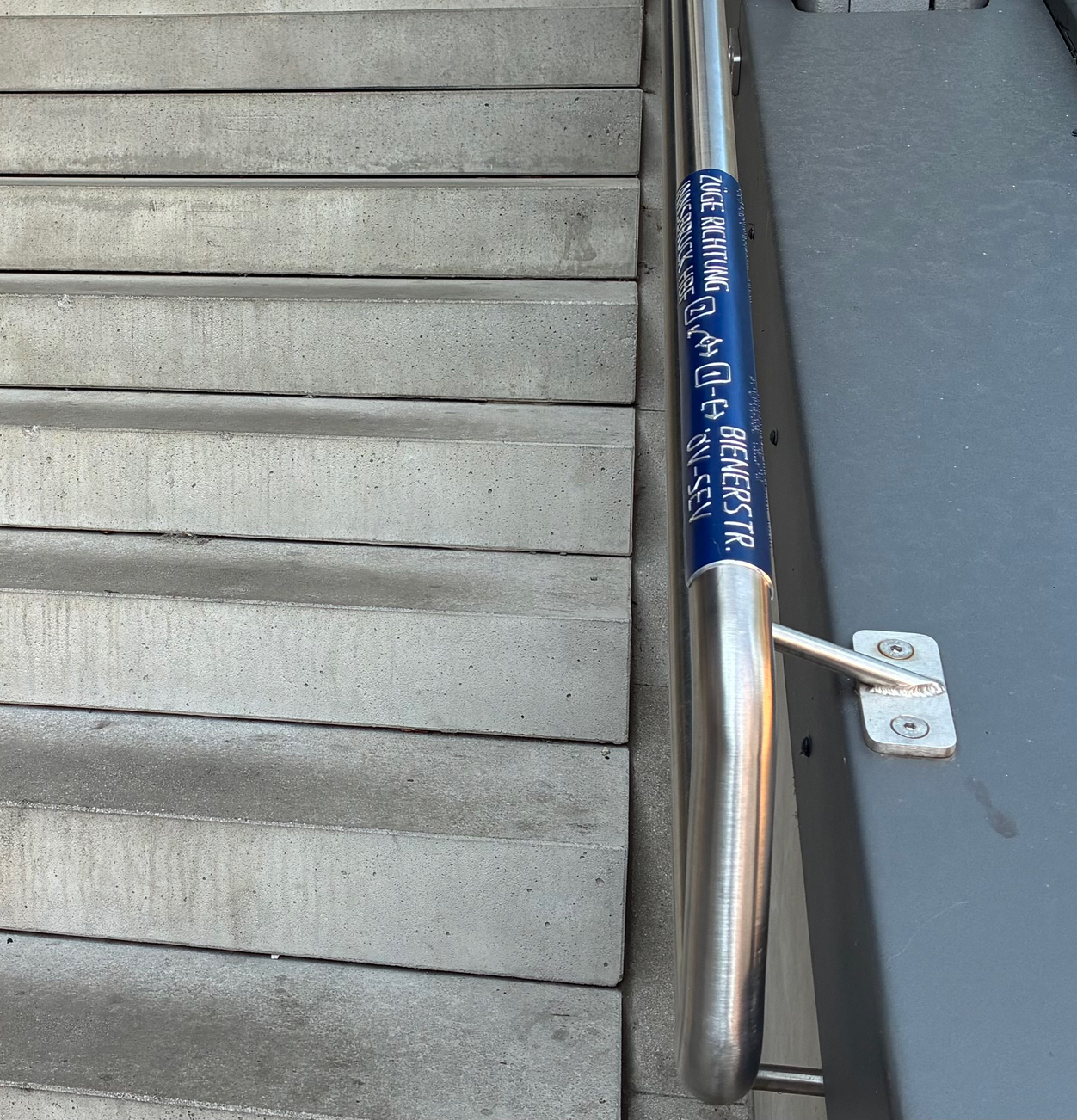
Tactile information on the handrail at the foot of a flight of stairs© Stadt Innsbruck/W, Grünzweig
What is the purpose of the grooves and studs on the pavements?
If there are no guide lines, or if they are unusable, tactile ground markings in the form of grooves or studs are installed. In the direction of travel, the grooves guide blind or severely visually impaired people safely between obstacles.
Perpendicular to the direction of travel, they act as guide lines, indicating, for example, pedestrian crossings or the front edge of bus stops. Pedestrian crossings are also marked with grooves running across the crossing so that a person can use their white cane to feel whether they are still within the safe area of the pavement or have already stepped onto the road or cycle path. Bus stops are also marked with a large area of raised dots. If a person using a white cane and/or a tactile loop is standing there, the driver announces the route and direction in which they are travelling.
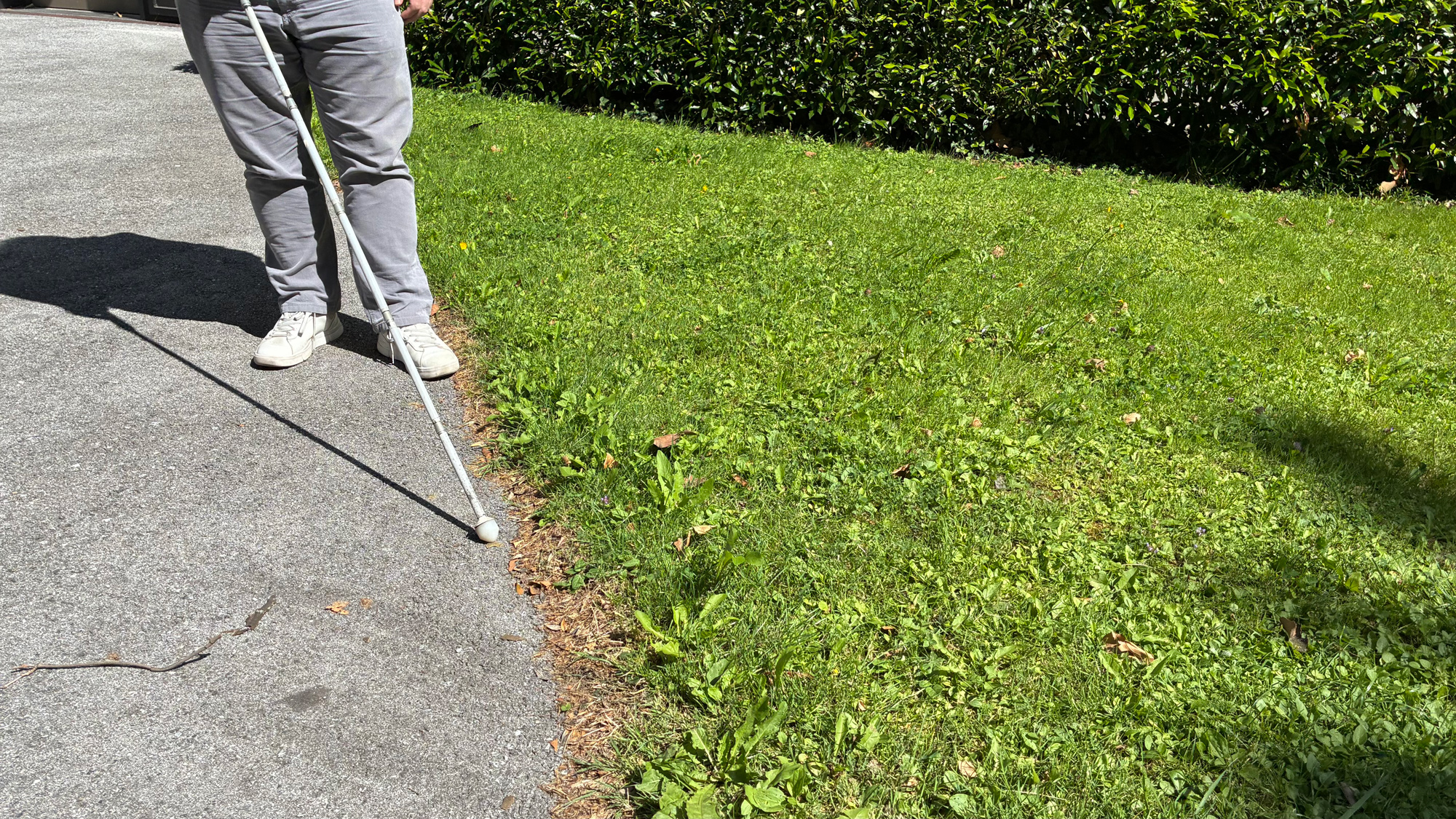
The edge of the lawn shows the way© Stadt Innsbruck/W. Grünzweig
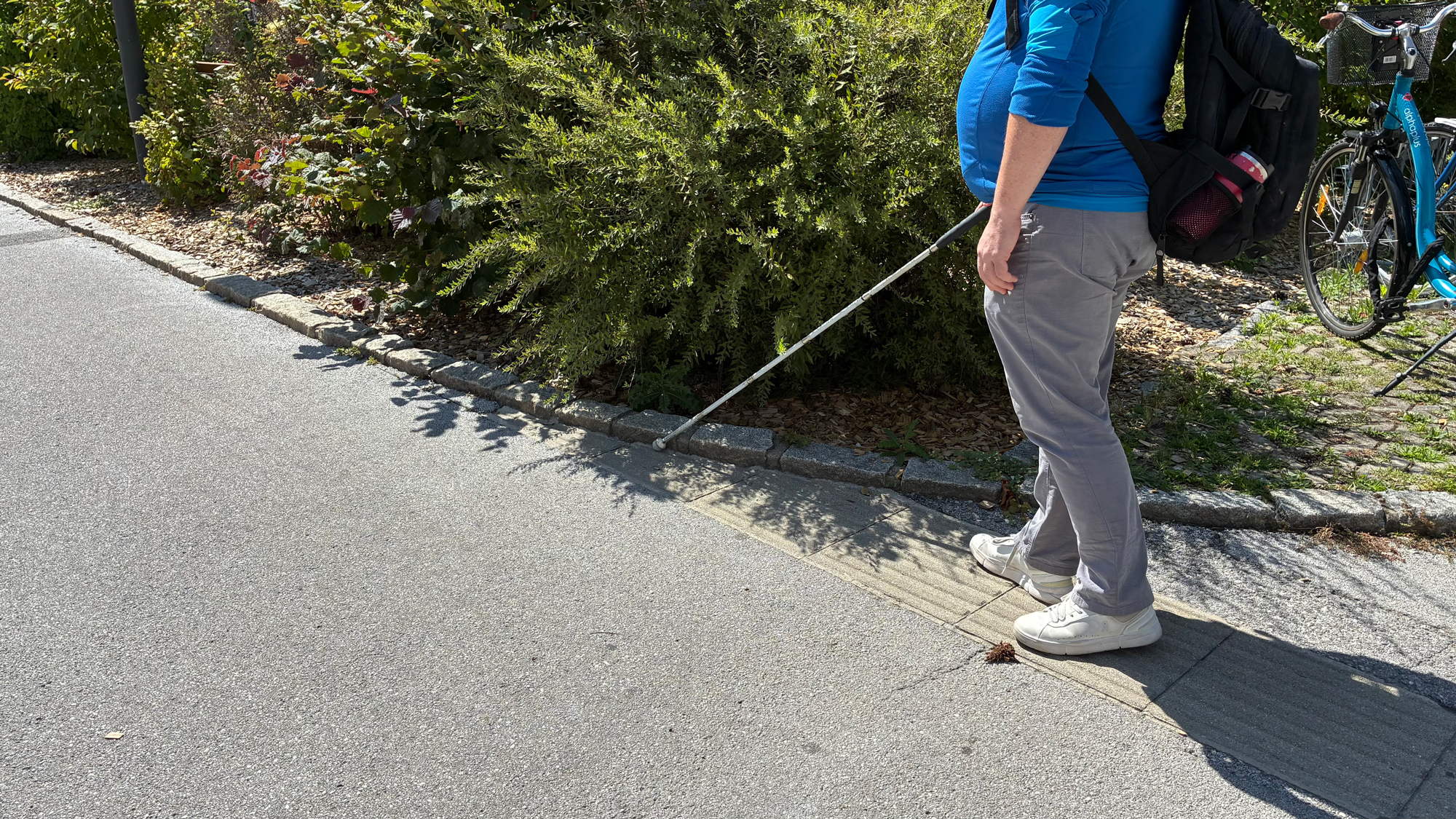
The kerb as a guide© Stadt Innsbruck/W. Grünzweig
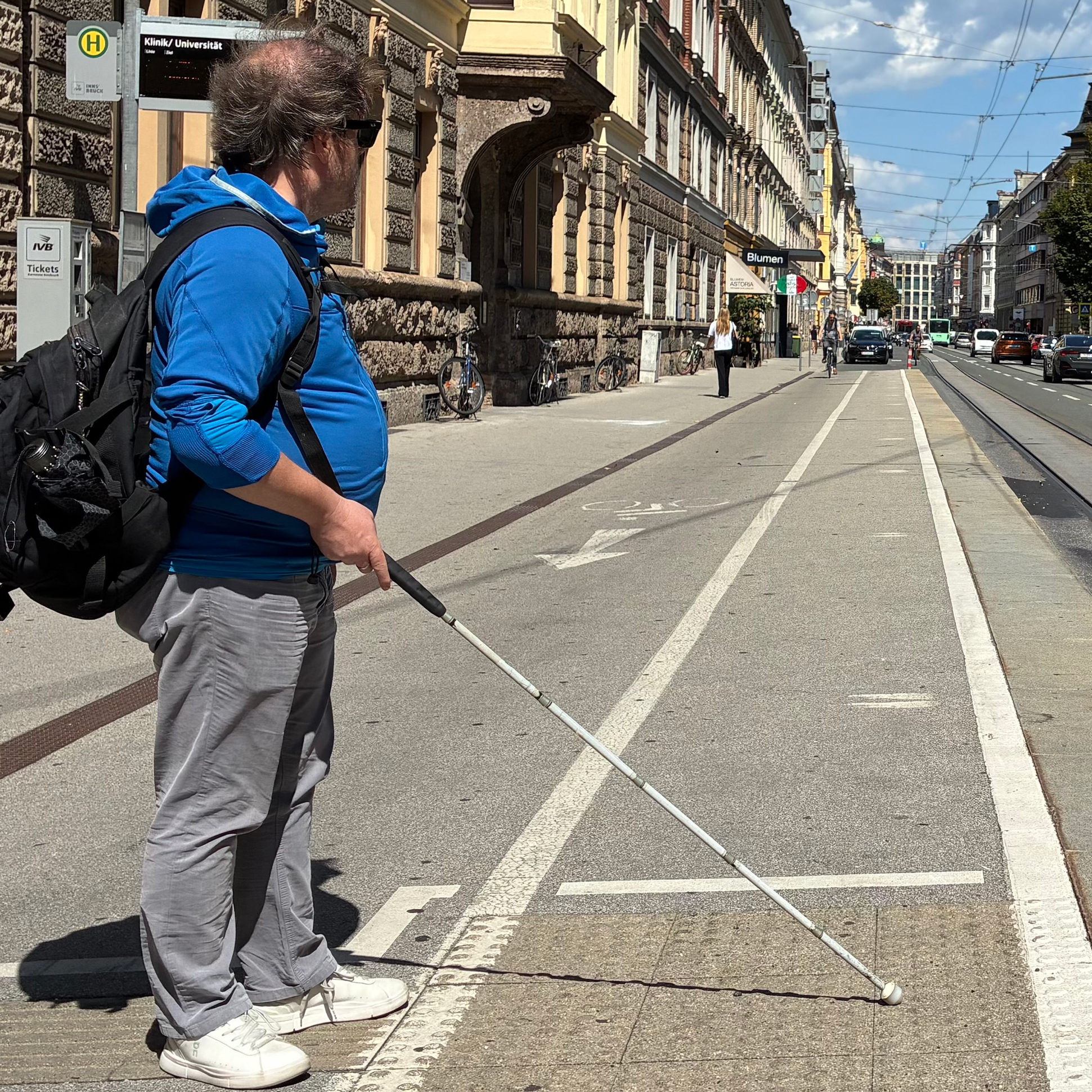
Eye-catching display at the bus stop. © Stadt Innsbruck/W. Grünzweig
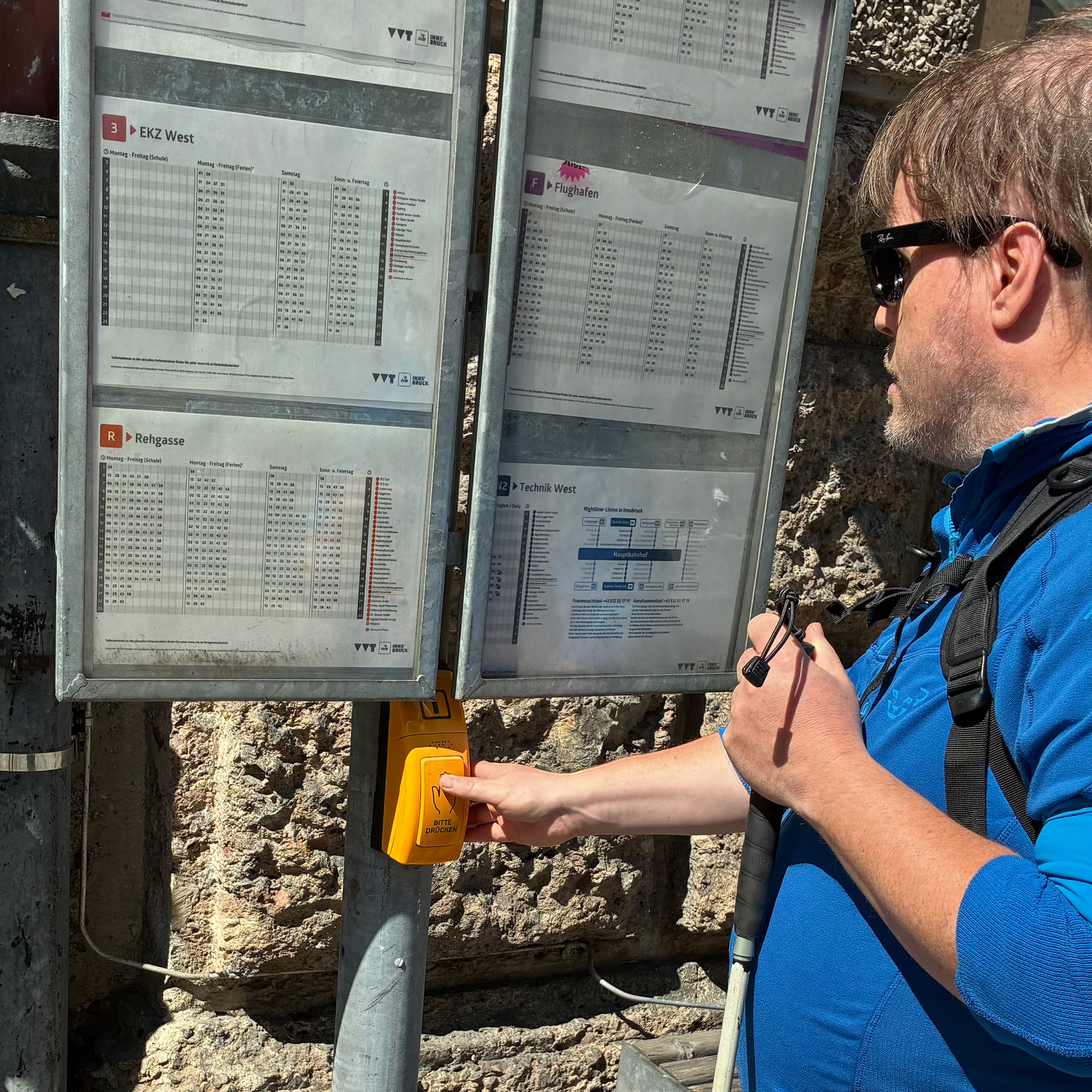
When the information button is pressed, the current departure times at a bus stop are announced.© Stadt Innsbruck/W. Grünzweig
How do you feel your way using a long white cane?
The long cane is also known as a white cane. It allows you to feel your way across different types of ground. Most long white canes have a small, rounded tip. This allows the cane to glide or roll over the ground as you walk. When crossing grooves, bumps or other features in the ground, different levels of resistance are encountered. The cane transmits these sensations to the hand. The sound of the cane rolling or touching the ground also changes on different surfaces. This enables blind and visually impaired people to sense and even hear guide lines. They can tell when the direction changes and can navigate more confidently.
To use a white cane correctly and safely, you need to practise a great deal. During orientation and mobility (O&M) training, the BSVT teaches key techniques for using the white cane. People who are blind or visually impaired use all their senses during these sessions. They learn to find their way around their neighbourhood more effectively, to use buses and trains, and also to protect themselves. You can find more information about the training at the Tyrolean Association for the Blind and Visually Impaired:
What makes it difficult for people who are blind or have a visual impairment to get about?
Bicycles or scooters are often left on the guidance system. The white cane gets caught and the bike falls onto the person who is blind or has a visual impairment.
The video shows a person with a white cane walking along a path. Just before they reach the guide lines, a hairy character called Wuschl steps in front of them and parks a scooter right on the guide line. The person raises their hand and comic-style symbols indicate that they are annoyed. Wuschl flashes red. The scene is rewound and played again. This time, Wuschl does not park the scooter on the guide line and the person can continue walking unhindered. Wuschl flashes green. The person is seen blowing a kiss, and red hearts fly through the air. The video ends with the words ‘Innsbruck says thank you’ in large print, with Wuschl riding past on his scooter.
Obstacles at traffic lights
Incorrectly parked scooters, bicycles, rubbish bins or other obstacles are also a problem at traffic lights. For example, they can block access to traffic light activators. Incidentally, these can only be heard when people who are blind or visually impaired activate them using a handheld transmitter for traffic lights.
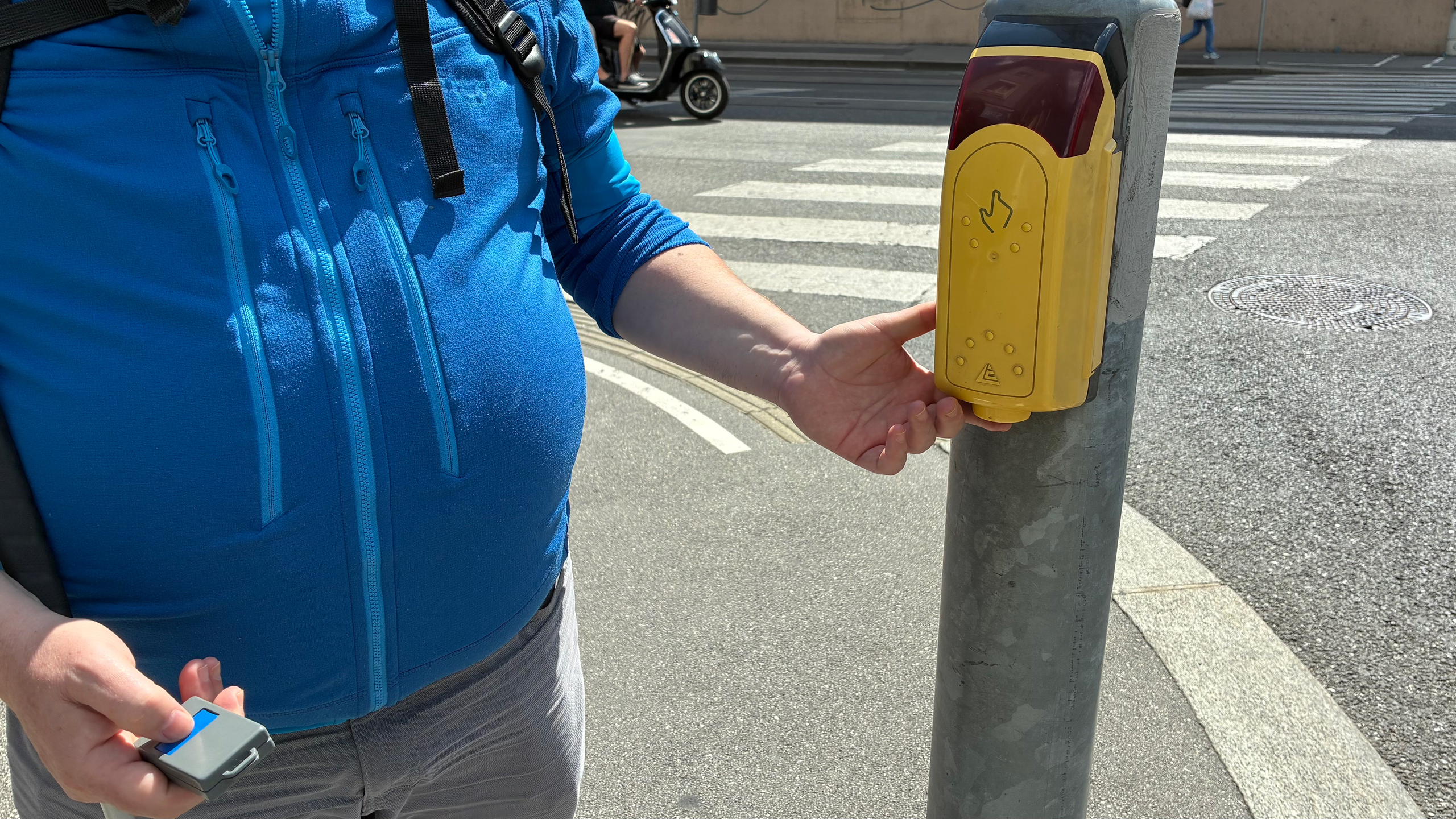
If you place your hand on the traffic light system, it vibrates when the light turns green. Furthermore, if a person who is blind or visually impaired presses the blue button on a request button, as shown at the bottom left of the picture, additional audible signals are emitted.© Stadt Innsbruck/W, Grünzweig
Obstacles on building walls and kerb edges
People with visual impairments also use building walls, kerb edges and other easily distinguishable surfaces to find their way around. Any objects that interrupt or obstruct such orientation lines can restrict accessibility.
The video shows a person in a wheelchair approaching the traffic lights. Just before they reach the yellow traffic light signal, a shaggy character called Wuschl rides in front of them and parks their scooter right in front of the signal. The person can no longer press the traffic light button, raises both hands in a questioning gesture, and comic-style symbols indicate that they are annoyed. Wuschl flashes red.
The scene is rewound and played again. This time, Wuschl parks in a designated parking space and the person reaches the traffic light without any obstacles. Wuschl flashes green. The person is seen blowing a kiss, and red hearts fly through the air. The video ends with the words “Innsbruck says thank you” in large letters, as Wuschl rides past on his scooter.
Text: Michael Berger, Deputy Chair of the Innsbruck Advisory Board for People with Disabilities, adapted and supplemented by Lea Stoll (BSVT) and the web editorial team.