How badly is Innsbruck affected by heat?
Heat poses major challenges for cities in particular. The reasons for this are dense building development, sealed surfaces and often low air exchange. Innsbruck already had a total of 25 hot days (days with over 30°C) in 2020. That is twice as many hot days as in Salzburg and up to 20 percent more than in Klagenfurt. The modeling also predicts an increase in hot days.
The temperature in densely populated inner-city areas can be up to 6°C higher than in the outskirts of the city. This is known as the heat island effect. In 2022, the city of Innsbruck had its own heat island effect visualized using an urban climate analysis in order to plan targeted measures to alleviate the situation.
How does heat affect the population of Innsbruck?
For the population of Innsbruck, climate change means, among other things, increasing heat stress - especially for vulnerable groups such as the elderly, people in need of care, people with pre-existing conditions or people who work outdoors, as well as infants, young children and pregnant women.
The increasing heat in cities harbours health risks and threatens to significantly reduce the quality of life during hot spells. The city of Innsbruck has a duty to ensure the well-being and safety of its citizens and visitors and to minimise heat stress wherever possible. To this end, the Service Unit Urban climate and environment is constantly working on a heat action plan. Individual measures were already implemented in summer 2024.
What measures is Innsbruck taking to combat the heat?
The City of Innsbruck is participating in the information campaigns run by the Province of Tyrol and the Tyrol Clinics. Awareness-raising content is published in ‘Innsbruck informiert’, on IVB information screens and on social media. Together with partners ISD and IIG, information materials are distributed in residential, care and educational facilities. You can find the information materials from the Province of Tyrol and Tyrol Clinics here:
Heat warning system
A warning system for heat waves and a population that is well prepared for possible health problems in advance can save lives. For this reason, the province of Tyrol has included all affected facilities in Innsbruck, such as nursing homes, retirement homes and schools, in the heat warning system set up by the public health service. This system warns the facilities of heatwaves in which it will be 30°C or more for at least three days in a row. The facilities can thus take precautions in good time to protect their residents, users and employees from the impending heat and ensure the functioning of the facilities.
Water stations in Innsbruck's businesses
Another anti-heat measure by the city of Innsbruck is the so-called water drop campaign. Since 2021, stores, restaurants and other publicly accessible establishments have been able to display a sticker with a drop of water provided by the city to signal that everyone is welcome to fill up their water bottles with tap water. Together with the IKB and the Tyrolean Chamber of Commerce, the city of Innsbruck is inviting companies of all sizes and from all sectors to join the campaign and make a positive contribution to a liveable Innsbruck. There are already numerous participating companies.
Join them too!
The stickers are available for collection from Service Unit Citizens’ Services and Lost Property Service, IKB customer service (Salurner Straße), the Roßau recycling center and the Tyrolean Chamber of Commerce (Wilhelm-Greil-Straße).
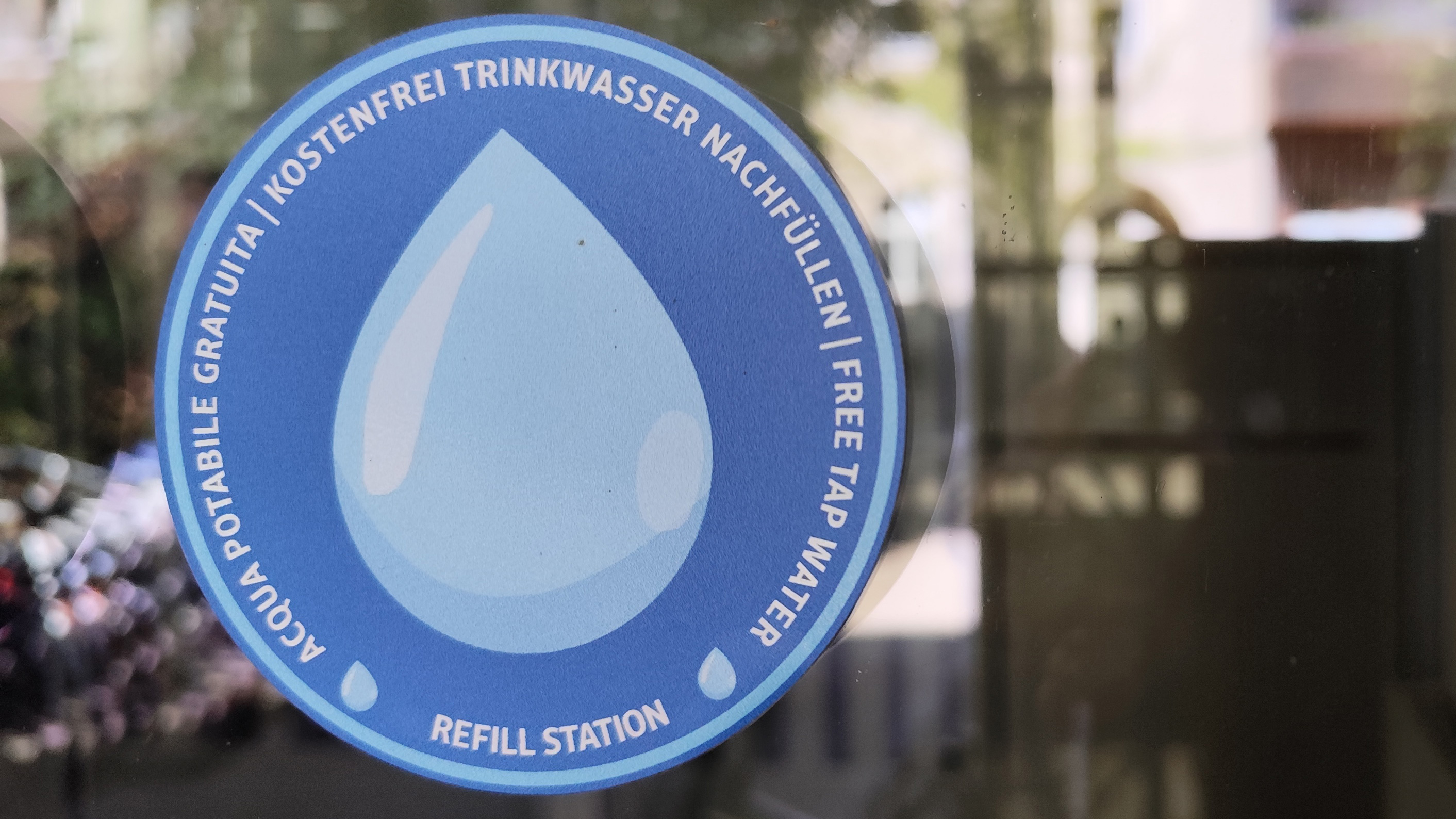
The sticker shows where you can top up your water bottle for free.© Stadt Innsbruck/VH
Cooling zones
Cooling zones are cool, easily accessible and free-of-charge indoor spaces that offer seating, information, usually a toilet and access to drinking water – for example, in the ISD halls of residence, shopping centres or the city library. The cooling zones are being set up by Service Unit Urban climate and environment as part of the Heat Action Plan. There are currently twelve cooling zones in the Innsbruck city area. Cooling zones are currently located at the following sites:
- Reichenau Hall of Residence
- Pradl student residence
- Olympic Village Hall of Residence
- Innere Stadt Hall of Residence
- Hötting Hall of Residence
- Lohbach Hall of Residence
- IKB Customer Centre
- Tyrol Department Store
- The Raiqa
- Tyrol Chamber of Commerce
- DEZ
- City Library
The cooling zones are complemented by the INN oases run by Caritas Tyrol.
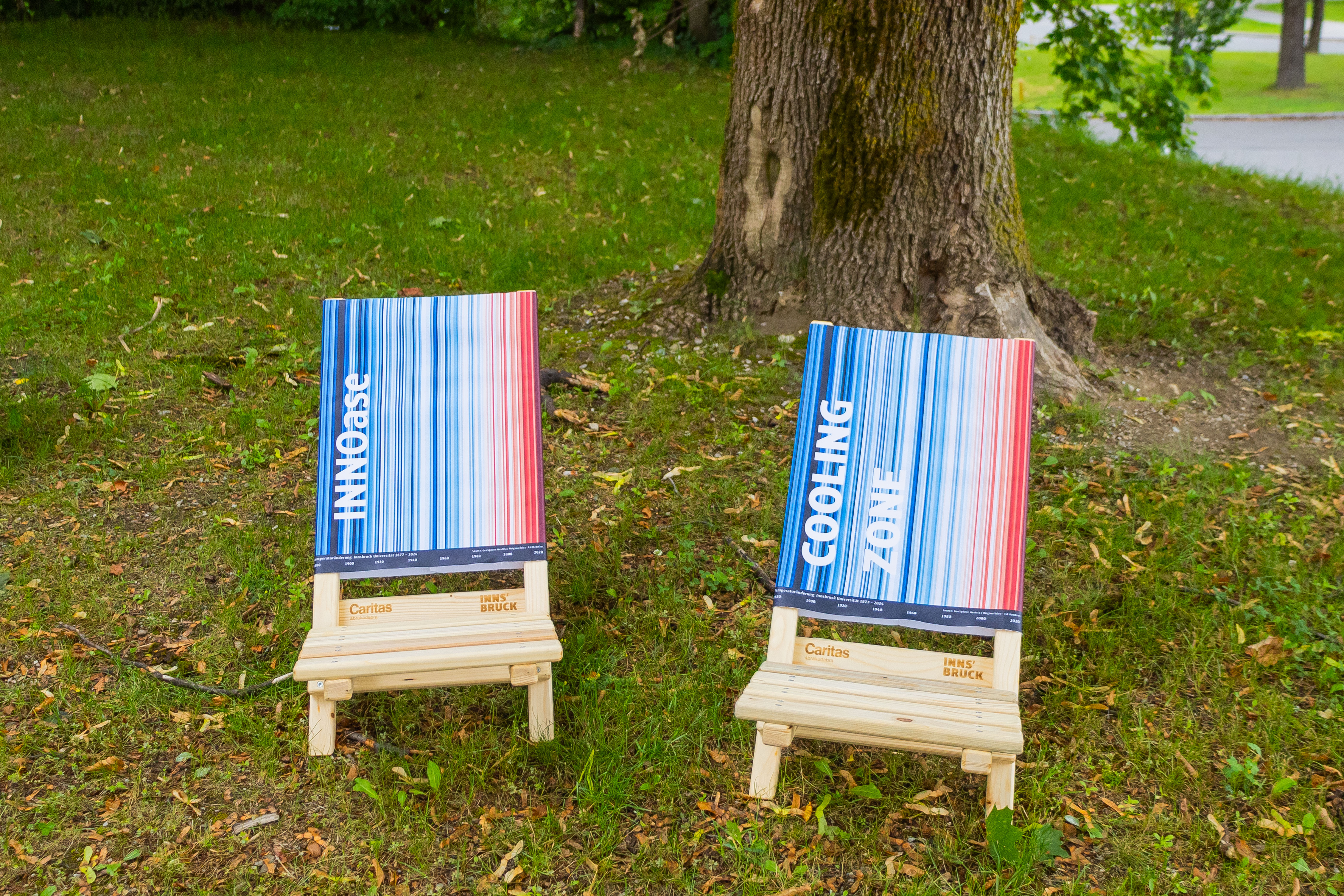
Cooling zones and indoor oases can be recognised by the branded folding chairs.© Stadt Innsbruck/F. Bär
You can find an interactive map showing all the sun cream dispensers, cooling zones and INN oases in Innsbruck here:
Sun cream dispenser
Apply sun cream and protect yourself!
Under this slogan, three sun cream dispensers were installed in the city of Innsbruck in mid-May 2026 – as a joint project between the City of Innsbruck, the Province of Tyrol and the Alpenzoo. The dispensers are currently located at Marktplatz, Landhausplatz and in the Alpenzoo, and are individually branded. High-quality sun cream is available free of charge from May to September.
For anyone interested, the current UV index and temperature are shown on the display of the sun cream dispensers. The electricity for this is supplied by a small photovoltaic module. The high-quality, water-resistant sun cream with UVA & UVB filters has a sun protection factor of 30, is paraben-free and suitable for people with allergies. The company Sundo is fully responsible for maintaining all three dispensers, so the sun cream should never run out.
The sun cream dispensers were originally proposed by members of the public last year as part of the heat action plan within the ‘Let’s Beat The Heat’ public participation process. We have now been able to bring this idea to fruition with our partners.
Further measures to combat heat stress
The City Department Climate-neutral city has collected extensive data and used it to produce an urban climate analysis. This identified and located the heat islands expected in densely populated areas. On this basis, countermeasures such as greening, shading, the provision of (drinking) fountains and the removal of impervious surfaces are being implemented.
Projects are being implemented on an ongoing basis through the implementation of the tree-lined avenue concept, climate-friendly streetscapes and square designs such as cool-INN (Ing.-Etzel-Park) and COOLYMP (DDr.-Alois-Lugger-Platz). When it comes to raising awareness, the city is working in partnership with organisations beyond its borders through new collaborations and is constantly expanding these.
Tips for dealing with heat stress
During heatwaves, it is extremely important to prevent emergencies. The following tips can help:
- Drink regularly throughout the day (e.g. water, mineral water, diluted fruit juices).
- Eat light summer meals (plenty of fruit and vegetables, salads, etc.).
- Cool your body with damp compresses (on your head, neck, hands or feet).
- Run cold water over your wrists and ankles.
- Take a cold shower.
- Use cooling water sprays.
- Keep your home cool by ventilating ( early in the morning and at night) and using fans.
- Darken your home using blinds, curtains or shutters.
- Switch off any heat-emitting appliances in your home. Heat is also generated when appliances are on standby.
- Make sure you take your medication correctly.
- Ensure you follow the recommended storage temperatures for medicines. Temperature fluctuations can reduce their effectiveness. Ask your chemist for advice on this.
- Stay in the shade .
- Wear light clothing and sun protection ( sun hat, sunglasses, sun cream).
- Avoid strenuous physical activity in the midday heat.
- Be aware of the symptoms and physical warning signs of overheating.
- Keep an eye on your neighbours and offer them support in an emergency – older people, those living alone, people who are unwell and children are particularly in need of help . You can find tips on first aid for heatstroke here .
- Check the local news for the latest weather conditions and forecasts.
Symptoms and physical warning signs
Signs of health problems such as overheating, sunstroke, heat exhaustion or heatstroke can occur even some time after spending time in a hot environment. Symptoms include:
- severe headaches
- dizziness
- a feeling of exhaustion or weakness
- Dizziness or blurred vision
- Nausea and vomiting
- Circulatory problems and loss of consciousness
- Concentrated urine
- Muscle or abdominal cramps
- High body temperature
- Cardiac arrhythmias
First aid in an emergency
If you notice the above symptoms in another person, please administer first aid. You can take the following measures immediately:
- Get out of the heat or sun with the person immediately. Go indoors or into the shade of trees.
- Remove or loosen tight clothing.
- Cool the head, neck, hands and feet with damp, lukewarm cloths.
- Give the person fluids (tap water, mineral water or very slightly salted water). Caution: This does not apply if the person is unconscious!
- If severe symptoms occur, call the emergency services (144).
Contact
Urban climate and environment
Opening hours
Office:
Monday, Wednesday to Friday:
9.00-11.30 a.m
Tuesday:
13.30-16.00 and by appointment
Phone:
Monday, Wednesday, Thursday:
9.00-16.00
Tuesday:
11.00-16.00
Friday:
9.00-11.30 a.m