Prize money: 10,000 euros
The prize is awarded annually and may, at the discretion of the prize committee, be split, for example into a main prize and an encouragement prize. There is no obligation to award the prize every year.
What is the prize for?
The Marianne Barcal Prize has been awarded since 2016 for outstanding academic achievements in the field of 20th- and 21st-century history, preferably with a regional and/or gender focus, within the discipline of history and its related fields.
Marianne Elisabeth Barcal bequeathed her entire estate to the City of Innsbruck, earmarking it for the purpose of the Service Unit City Archives/City Museum As the testator was a keen student of contemporary history and political science, the City of Innsbruck has established a prize from her estate. The aim is, on the one hand, to honour her memory and, on the other, to strengthen the ties between the university and the city.
Who awards the prize?
The award committee comprises the following individuals or their authorised representatives:
- The Head of Municipal Department V (Society, Culture and Housing) of the City of Innsbruck as Chair
- The Head of the Innsbruck City Archives/City Museum
- Head of the Institute of Contemporary History at the University of Innsbruck
- Head of the Institute of History and European Ethnology at the University of Innsbruck
How do I apply?
Applications must be submitted by 12 January 2026 and sent exclusively in digital form to barcal-preis@uibk.ac.at.
What documents are required?
- Thesis including the external examiner’s report (for doctoral theses) or a detailed statement from the supervisor (for diploma theses and Master’s theses)
- CV with a description of academic activities/research, including a list of publications
- Submission of any other documents as requested by the awards committee
Who is eligible to submit an application?
The prize is intended in particular to support early-career academics and is open to final theses (diploma theses, Master’s theses, dissertations) in history, political science and related disciplines. Theses assessed more than three years ago will not be considered.
Employees of the Innsbruck City Council are excluded from applying for the Marianne Barcal Prize.
What can be submitted?
Only final theses (diploma theses, Master’s theses, doctoral theses) completed at the University of Innsbruck, where the assessment took place no more than three years ago, will be considered.
When will the next call for entries take place?
The next call for entries is expected to take place at the end of 2026.
Previous award winners
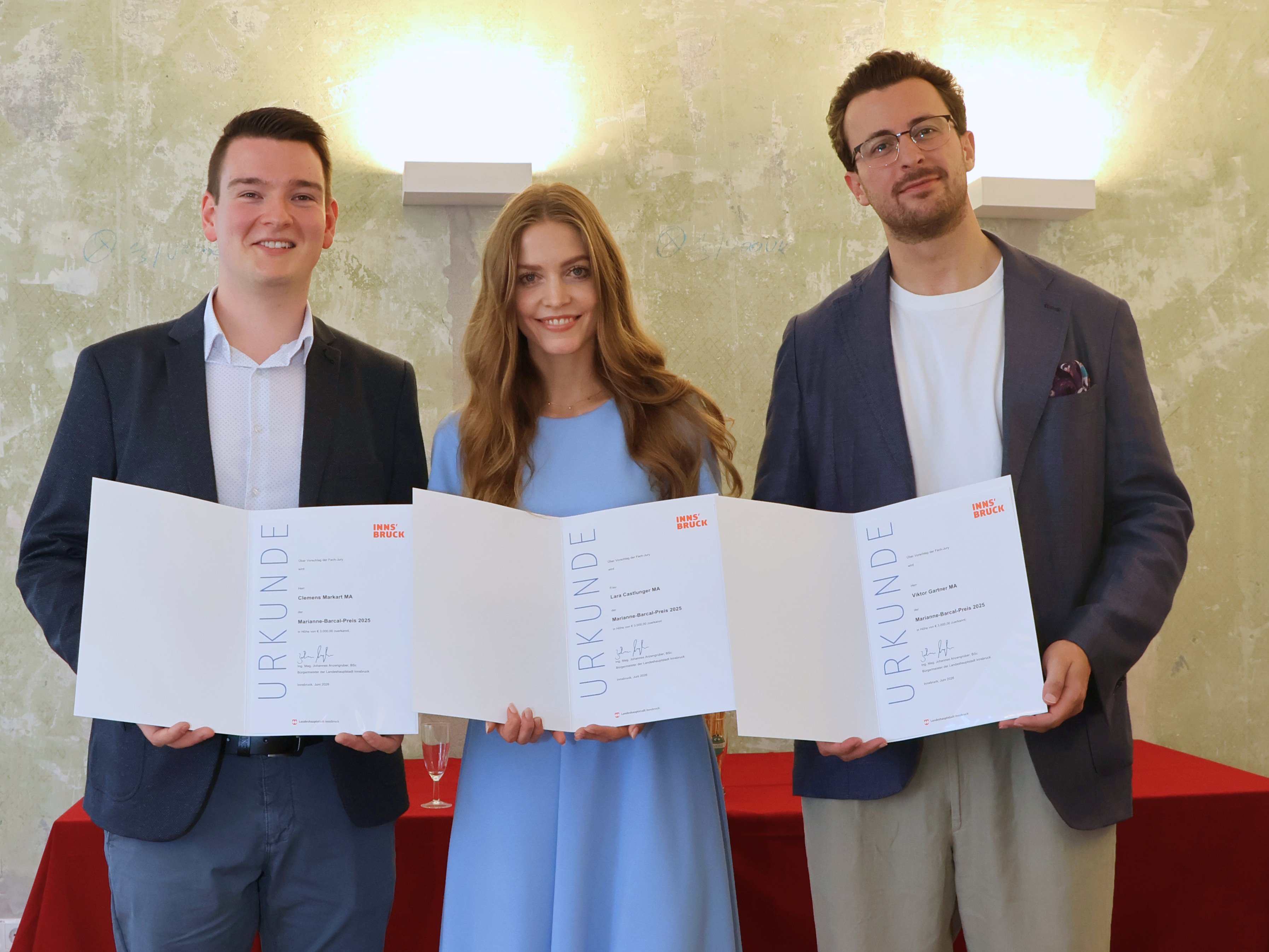
The winners of the 2025 Marianne Barcal Prize: Clemens Markart, Lara Castlunger and Viktor Gartner © Stadt Innsbruck/A. Steinacker
| Year | Winners |
|---|---|
| 2025 |
|
| 2024 |
|
| 2023 |
|
| 2022 |
|
| 2021 |
|
| 2020 |
|
This might also interest you:
Contact
Opening hours
Monday to Thursday:
9.00 am–12.00 pm and 1.00 pm–5.00 pm
Friday:
9.00 am–1.00 pm